Saturday, 27 June 2015

Hue Ball, A Metaphor For How We've Made A Mess Of Things

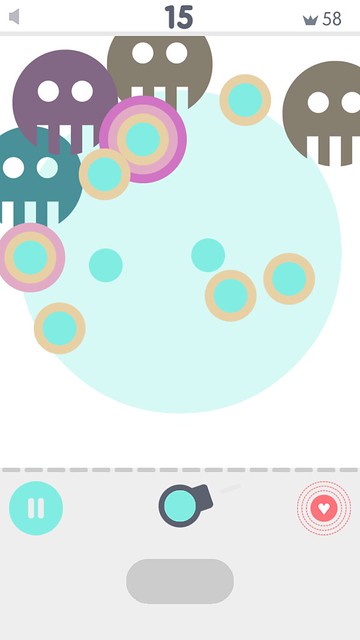
Saw a review of Hue Ball, an iPhone game, posted on Twitter. Described as addictive. I downloaded it and started playing. Essentially you start with a cannon swinging left to right and three stationary coloured circles on the screen. Every several seconds these 3 circles will develop layers and the player is supposed to shoot circles/balls from the cannon to prevent these layers from accumulating. Each layer or circle destroyed is a point earned. Targeting a circle is much like playing snooker or pool. You can aim straight or bounce off other circles or balls or the walls. So that's the skill but I guess. Each layer is a colour hence 'Hue 'in the name of the game. Admitted the colours get pretty as they layer up.

Start
Three things to be aware of. One, the layers can't exceed five else the circle becomes a permanent skull face. So the player has to keep the shooting and aiming right. Two, each ball shot out becomes a layer-accumulating circle. So the more you shoot, the more you have to shoot at. Three, when the ball you shot out bounces back towards and touches the cannon line, the life counter decreases. So the more bad ricochets that happen, the quicker the game is over.

I've been playing this game for about two weeks. It is fun but then I got existential about it. The game is a metaphor for humankind! Hear me out - you start off with a cannon that's doing nothing, minding it's own business (that's people).  The 3 circles in the open frame are just out there accumulating layers as time goes by (that's the earth or animals or plants). One is compelled by the need to earn points (that's greed or need to be a busybody) to blast a cannonball out at the three circles. Left on their own these circles would turn into skull faces and the player wouldn't even be affected or suffer any disadvantage. The need to intervene and perhaps gain a perceived advantage compels the player to shoot balls, with or without realising that this action causes an immediate effect on the external environment, and also has a lingering long term effect that needs to be dealt with sooner or later. The more shots fired, the greater likelihood that the open frame is pitted with more circles to contend with, each one growing as time goes by. See where I am getting at? 

The mess after a while
Let's say the open frame represents the environment. The more we mess with it or try to control it, the more problems we create. We chop down trees to make stuff. There's less forest to clean the air and control greenhouse gases. The animals too have nowhere left to hide and enter our cities. We then have to deal with more issues than we started with. 

Let's say the open frame represents Saddam-era Iraq. The problems were there but not the kind that the western powers said there were (as later proved). A coalition of the willing was raised to liberate Iraq from tyranny and mayhem at a huge financial, moral and human cost. And today, we are nowhere close to having a peaceful Iraq. Each intervention caused more bloodshed, more lives lost, more confusion among locals and allies, less trust between the Arab States and the West, more pockets of self-styled militia waiting to get a piece of the action with no simple end in sight. The more cannonballs shot out, the more balls to juggle, manage, deflect and solve for. 

For every action, there is reaction. For every cause, an effect. That's what Hue Ball is about. That's also what life is about. 

We're here to do God knows what. Survive maybe. On a TV commercial for a green movement, there was a line "We need the Earth to survive, the Earth does not need us." It's true. Leaving this alone is sometimes the best thing to do. 

Sort of leaving things alone
Another line from a song comes to mind too - the road to hell is paved with good intentions. A shocking statement to say the least. But think about about all the things that have been done in the name of all that is right, good or holy that have ended in varying degrees of fiasco, mayhem and arsed up. 

It's the history of humankind, in a harmless point and shoot game. 


Monday, 30 March 2015

I Grew Up With Lee Kuan Yew

grew up with Lee Kuan Yew. My dad always made his priority to be in tune with Singapore politics and the ongoing witty repartee between JB Jeyaratnam and LKY always tickled his fancy. In my home we knew who LKY was and what he had done and what he was doing. My dad always made sure the only channel on at news time was the channel with the news. We saw LKY and his ministers on our black and white TV but ignored them. We were kids so what did we care. My dad would mutter things under his breath and sometimes out loud whenever something important was announced by the newscaster. Perhaps Duncan Watt. My father also enjoyed our tit-for-tat exchanges with Malaysia aka Mahatir. 

This was the 80s, when the Singapore dollar was gaining strength against the Malaysian ringgit. I remember notices on SBS buses reminding passengers not to use Malaysian coins anymore. I was in primary school. Singapore politics was as important to me then as learning to make chappatis. (I still can't make chappatis.) And LKY was Prime Minister and that was all that mattered. I was very proud of my little country. I was fascinated by how the economy had grown, that people moved from kampongs to flats, we had a spanking new airport (My dad brought my sister and I to the opening day of Changi Aiport, 1 July 1981. I remember the falling water columns and the crowd.) and many tall buildings in the city. And double decker buses. And that the MRT was coming. Oh boy trains! We were poor, and the affluence around me was astounding and impressive. To be hankered after. 

I can't really recall much about LKY and Singapore politics in teenage years. I know LKY left his role as PM in 1990 and Goh Chok Tong took over. (There was this disturbing picture of GCT and some ministers in their swimming trunks on the Straits Times front page. Shudder.)

I guess the other key thing that stood out to me from a young age while in LKY's rule was that he sued many people and publications. He always won. 

It was in JC when my mind was opened to the possibility that the politics in my country was special, and not necessarily the best for her people. Gasp! I blame GP, it did its job. When you're open to ideas and exposed to other schools of thought, policy and government, you start to better appreciate, comprehend and question your own status quo. Then came National Service, the true melting pot of all and sundry, from all walks of life, every man from the brave to the depraved. I could not blame LKY for NS because I knew Singapore needed conscripted men to ensure its freedom would not never be at stake. At the same time, I knew people who hated NS and by extension LKY. They felt NS was a waste of time, a quantifiable loss in the prime of their lives, an unworthy taxation on time and talent. I just went on with it, hoping to finish my time unscathed (everyone comes out scarred, in one way or another). 

University was a time for ideas, and more thought about my country and where it was heading. There was localised politics, voting for committee leadership in clubs and halls of residence. It was silly and inconsequential, though I know some ambitious types took it very seriously. I learned then what it meant to have power. I remember hall presidents making bold statements and acting like their lives depended on the permeable hearts and minds of their residents. They planned actions and words carefully so as to achieve a desired outcome, or at least the perception of a successful conclusion. I was impressed. I also came to understand how political office could shape one's character, for better and worse. More importantly, I came to associate power with money, that he who has one without the other is handicapped like a rich prince in waiting - stuck in a tunnel vision of ambition but constantly bugged by those who want to leech along for the ride. He who has both is king. (In Singapore, there are many kings it seems.)

Am I jaded by the political system LKY spawned? Perhaps. Maybe because I see the government's hand in everything. The whole country was the result of something truly planned, completely inorganic. Many are thankful for the peace, stability and affluence that LKY's vision manifested into. I am also. There is no place on the planet like Singapore. The problem perhaps is that the hand in everything has taken away for the need for the people to step up. The reliance on the government to solve our problems has created a creative vacuum, and a debilitating apathy toward proactivity. We merely complain when things go wrong, gripe and moan at the slightest inconvenience. In the era when little went wrong, we hardly questioned the leaders that be, because there was no reason to. Also due to a fear perhaps instilled in us by LKY. We owed him so much - the success of this island, its regional and international standing, our rapid ascent into the First World - that we dared not bite the hand the fed us. That was the generation that grew up in the 60s and 70s, the ones who saw, felt and enjoyed the most change. They were submissive and obliging. They saw how those who even slightly smelled of dissent were dealt with. Zeus was liberal with the lightning bolts from Mount Olympus. There seemed to be just one way, his way. Those who grew up in the 80s and 90s were surrounded by the prosperity the LKY way wrought. These youngsters had less to be thankful for in a way, as recipients of their parents' hard work and perseverance. Lower marginal utility I suppose. Not surprisingly, it is their voice which is now heard loud as it calls for change in the way our government thinks and acts, a generation demanding more, appreciating less - a scenario unfamiliar in the times of LKY's reign. 

Every beginning has an end - a fade into white. Lee Kuan Yew thrust himself into the political scene to make change, way back in 1954, a time of much tension, some turmoil and a little upheaval. He persuaded his followers to support the merger with Malaysia, saying we could not survive as a small island alone, then to take steps to forge nationhood when Malaysia no longer wanted this troublesome little tip of the peninsula. He had a plan and a team of similarly motivated politicians who wanted to see this little red dot glow red hot. Every man, woman and child regardless of colour, language or belief, united in making things better with action, ambition and energy. And it worked. LKY's magnum opus is the ground I walk on. Last week, he passed away at the age of 91. So we begin again? No, we have always been challenging ourselves to be better. The storms and winds may be very different from the weather in 1965 but our foundations today are stronger, built upon the blood and character of many good men and women. What's not new is that we know we can make it, because we know have to. LKY has shown us how. It is the indefatigable Singapore spirit coursing through the veins of a still young nation that will lead us. There will be compromises to make, there must be open-minded consensus to underscore our actions. Every end has a beginning - a spear of red. Majulah Singapura.

Wednesday, 11 March 2015

Disservice In Singapore

Singapore isn't known for great service. Not many waiters say "hi hello how are you?" when they come around with the menu. Cashiers simply glance at you to ensure there's a living being before them. Sales assistants at shops often simply stay behind the counter or follow customers around the store to annoy them further. There isn't a culture of politeness that extends to acknowledging customers or a system to exchange conversation such that it drives to a sale or at least a pleasant experience. What's worse is that many frontline staff adopt a path of least activity approach to their jobs. They won't make eye contact or smile; they will only help when asked; and won't think of solutions to slightly out of the box problems. It may be something we're used that any positive deviance to this norms strikes us as extraordinary. Like a bus drive who greets his passengers as they board or wait staff that bring water to the table without being asked. 

I was on holiday in Spain last year and almost every shop I went into I would hear the word "Hola" followed by a smile. It was a simple gesture that implied courtesy and presence. One couldn't help but "Hola" back. I wish counter staff at McDonalds here did that at least. 

A few Saturday's ago, I found myself at Kinki, a bar at Customs House near Clifford Pier. I had walked from Gardens By The Way where I had met friends for lunch. The journey had taken me past MBS where many bars and restaurants were already putting out Happy Hour signs to attract new patrons. I suspected Kinki would too have a similar scheme on. It was 5pm and I was customer number one. I waited for them to set up slightly (I was a tad too early) and ordered a drink. I pleasantly enjoyed the solitude and the great view while the staff went about their merry way and the loud rap music blared. I went on to order a second drink. When it was time to go, I signalled for the bill. $30. I asked the waitress if there was a happy hour thing they did. She replied it starts at 6pm.  Six bloody pm. Maybe it was the cheapskate in me or the fact that there was no other customer around, I was miffed. I told the waitress to go tell her manager that I was upset that I wasn't accorded the discount. She smiled sweetly. She must have thought I was joking. When she returned with the receipt, I asked her again. She hesitantly replied the manager wasn't around. She went back to her bevy of service staff and probably expressed my annoyance. One of the bartenders looked up at me and shouted that it was the system and that they couldn't manipulate it. Still not helping. I shouted back that they owed me two drinks. The bartender dismissively flashed a thumbs up. Sigh. I told them I wasn't coming back when I left. All of them just stared back. Clueless, hopeless and just doing their job. 

Last week, a bunch of my friends and I went on a trip. One of the said friends was 29 weeks preggers. Her doctor had said she was ok to travel and confidently she strode up to the Cathay Pacific counter at Changi Airport to check in. The nice CX lady asked a few questions as formality required. Ultimately the airline wasn't going to let my friend board without a doctor's letter. All this aside, what was lovely was that the nice CX lady said that they had printed a copy of the faxed letter for my friend to keep for her return flight, that it'll be waiting for her when she boards. Now wasn't that thoughtful?

Now there's a second nice thing that happened just about then. Another friend noticed just before boarding that her seat number was wrong, placing her 10 rows behind our group. Ay caramba. Her gallant boyfriend said no worries, he would take the odd seat. I thought hmmm, maybe the CX folks here at the gate could do something about this mistake. Guess what? They did! They called up the misplaced passenger who was given 63A and bumped him forwards to row 43 and reassigned my friend within company of her silly friends. Awww. See how nice Cathay Pacific staff are. They go out of the way to attend to needs. 

Excellent service is as simple as that. Meeting needs and sometimes exceeding expectations. 

So it's time service people and their managers (yeah you in Singapore) realise that customers are clued in and demand at least the basics. So they had better buck up or ship out. 

Thursday, 19 February 2015

Oh To Be A Bigger Dot

I've been provoking people, mostly my Singaporeans friends, with this hypothetical situation for a while now. 

"Would you agree to giving up all Singapore's reserves to buy over a piece of Johor?" 

The reactions I get are varied. Some people very quickly say no. The very thought of even contemplating that our $300 billion was spent on anything strikes fear, apprehension and downright nervousness. They respond with "Crazy lah you" or "Siao. How can touch that money?" and "Malaysia won't sell you anything. Water already want to fight already."

Others think about a little and venture a few questions to which I quickly spit out answers. I want their gut response as much as possible.

"How about some of the money?" Sure, I say, how about two-thirds. 

"How much land?" Let's say up to Muar then we draw a radius across to the eastern coastline. Sometimes, I suggest a 50km radius from Johor Bahru's city centre. 

"Do we keep the people or just the land!" We keep the people. Or rather we give them an option which side they want to join. 

"Wah what will happen ah?" I usually reply with statements like it'll be like when East Germany reunited with West Germany. It took a decade for them to get back on their feet but the whole nation is better for it. And our dollar's strength will be first to plummet of course, to say 1.5RM to the dollar but that's ok. We'll make up for this soon enough. And finally our NS boys would have something real to do. We'll move the airport further away. 

"Why do you ask this question?" Well, I've always felt we've been held back by our lack of land. We were booted out of Malaysia back in 1965 over political differences and have pulled ourselves in front economically with a high degree of affluence and prosperity. But our homes are expensive and cars are pricey. Our people are growing less happy with more people crowding this tiny space. Our supply of fresh water has always been something to worry about. 

There are bigger things too. Space, the lack of it or having enough of it, does things to people. It alters our mindset and perceptions. Things are easy administratively in Singapore because it's small. Public works, telecoms, infrastructure. Getting into the city is 45 minutes by train from the far ends of the island. When things are easy for people, two things happen - we get lazy and start to take the ease for granted. 

The people most affected by this affliction will be the second and third generations of Singaporeans, most of whom would have grown up with some degree of affluence, had one or more colour televisions at home, took taxis regularly, maybe had a car in the family. They experienced clean streets and working trains, nothing that makes life inconvenient or messy as most other people experience. With no need to think around how to solve day-to-day issues, there's a general apathy towards public service (someone else somehow gets the job done). 

Stretching that a little further (well to some extreme really), maybe our tiny, well-run country limits the need for creative thinking or innovation (last great thing we invented might have been Breadtalk's flossss bun) and little drive towards entrepreneurship (it's just too uncertain, give me an office job please). 

Little space also means less breathing room. There's no countryside to go do nothing in. No forest to frolic about in. No mountains to climb. No rivers to cross. No where to stop, take a long deep breath and smell the roses. Stress just kept inside a tightly wound city, accumulating. 

A friend who's been in the USA spoke about losing his job is too unhappy because he's saved. The rest of us felt he was going to be fine because he had options. Getting a cheaper place to stay was an option. Moving to another city or state was an option. Starting lemonade stand was an option. In a small country, options are more limited. In Singapore you'd get arrested selling lemonade on the street. I think there are cops after the folks selling curry puffs at MRT stations. 

There's a song called Big Country also by the band Big Country. The song came out many many years ago but the opening line in the chorus always stuck with me like a scar. "In a big country, dreams stay with you". I guess in Singapore most dreams are shaped by circumstances and decisions out of one's control. How on earth would I have become the astronaut I wanted to be when I was nine. Yes it sounds depressing but the reality is, in Singapore you make a living, you don't live life. I'm not ungrateful for my upbringing in this safe, clean and efficient city, aware that a few billion others wouldn't mind trading places. Perhaps I just need a road less travelled, literally and figuratively, to tread on. Perhaps I am just worried about how my country is going to grow up, how my friends' kids (yes, their kids because my friends are mostly resigned to their circumstances, and various forms of acceptable, non-threatening addictions to deal with their fates) going to look back and wonder if it was worth it. 

A time machine to go back and give Raffles a few ideas about territorial allegiances. If only.